From plastic packaging to packaging lines
''What I really need is a machine that places bags into boxes."
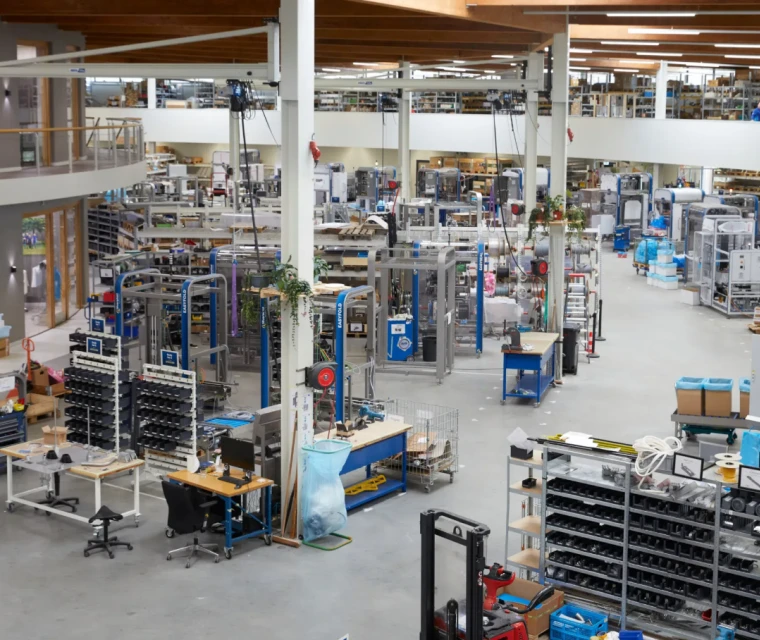
Almost forty years ago, Gerrit Jan Nieuwenhuis started manufacturing plastic packaging materials. Today, the impressive Niverplast headquarters in Nijverdal is primarily dedicated to developing and building machines that automatically place, fill and seal bags in boxes or crates.
This article originally appeared in a Dutch publication of Rabo & Co, july 2026.
Niverplast took off in the 1990s when founder Gerrit Jan Nieuwenhuis invented a system that made it easy and fast to place a plastic bag inside a box or crate. His son, Richard Nieuwenhuis, recalls:
"Back then, one of my father's customers said: 'The packaging materials you supply are great, but what I really need is a machine that places them in my boxes.' So my father built one. Without any prior experience in machine building, he developed the machine, and within a year he had already built twelve of them for that industry."
Complete packaging lines
Today, Niverplast designs and builds complete packaging lines in Nijverdal, while the core principle remains the same: automatically placing bags in boxes or crates, filling them and closing them. No two machines are exactly identical, however. Every solution is tailored to the product, the packaging and the customer's production process.
Developer Job Kleinsman explains:
"A typical Niverplast packaging line places a bag into a box or crate before filling it with products such as bread, fruit or meat. The bag can then be sealed and the box closed. Market-specific options, including vision systems for quality inspection, metal detection and checkweighing, complete the line."
Online supermarkets
The continued growth of e-commerce has also created new opportunities for Niverplast. Automatically placing bags in boxes and crates fits seamlessly with the way online supermarkets such as Picnic operate.
"Our T-Plast, developed together with Picnic, places three bags into a reusable plastic crate. The bags are filled with groceries and delivered to the consumer. After use, the bags are collected, returned and recycled."
While that may sound straightforward, developing the T-Plast was anything but simple.
"Picnic asked us to develop this machine. We then spent almost two years working together on its development. Today, more than fifty of these machines are operating at Picnic locations."
Although the machine was originally designed specifically for Picnic, Niverplast now supplies the same solution to other e-commerce companies as well.
Advanced machinery
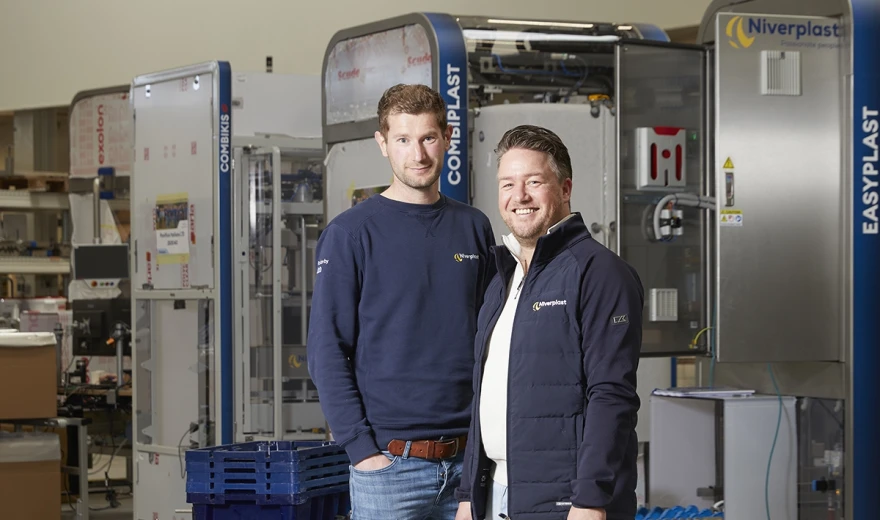
Nieuwenhuis and Kleinsman demonstrate several of the company's machines.
"This is the CombiKIS, where KIS stands for 'Keep It Simple'," says Kleinsman. "The CombiKIS originated from the CombiPlast, an advanced high-speed machine for placing bags into boxes. We recognised that smaller customers with more limited budgets were still looking for an accessible entry-level solution. The CombiKIS allows us to serve that market as well."
A little further on stands the Pick & Place module.
"This module uses two robots to accurately place products into boxes or crates. Thanks to its modular design, capacity can easily be expanded. We recently delivered a production line with twelve robots to Spain, capable of packaging 14.000 baguettes per hour."
As demand has also increased for machines that automatically place paper bags, Niverplast has developed the PaperBagger alongside its existing solutions.
At Niverplast, traditional management layers have been replaced by small, self-managing teams operating within the wider organisation. This keeps communication short, encourages equality and gives employees ownership. The philosophy is simple: happy colleagues create happy customers.
Packaging and plastics
- The name Niverplast stands for Nieuwenhuis Verpakkingen & Plastics (Nieuwenhuis Packaging and Plastics). It was chosen because, in the early years, all packaging materials were made from plastic. Today, the company also develops machines that automatically place paper bags.
- When Niverplast moved into its current headquarters in 2016, the company employed around 100 people. Today, that number has grown to approximately 300.
- Niverplast generates annual revenue of around €100 million.
- The company serves customers all over the world.
Author: Geert Jan Darwinkel
Photographer: Henk Wildschut